Resource Management Act Reform
Reforming New Zealand’s Planning System
Persons processing resource consents are now required to take all practicable steps to use efficient and proportionate processes, avoid unnecessary regulatory burden, and support practical decision-making. If you have a project in mind, we encourage you to contact the KDC planning team early so we can help you understand the requirements and identify the most appropriate pathway for your proposal.
The Planning Act and Natural Environment Act
The Government has replaced the Resource Management Act 1991 (RMA) with two new laws:
- The Planning Act - manages how land is used and developed.
- The Natural Environment Act - manages the use, protection and improvement of New Zealand's natural resources.
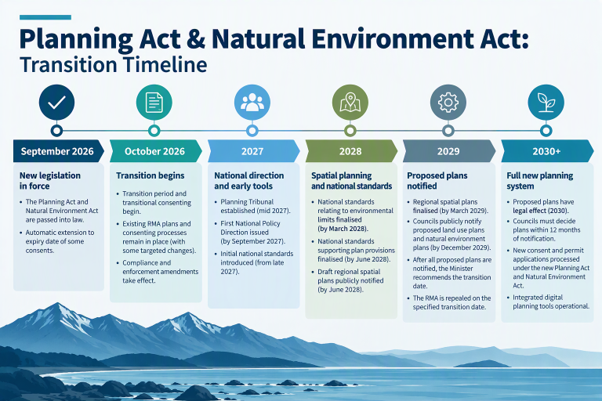
While the new legislation is now in force, the transition to the new planning system will occur over several years. Existing district plans and most resource consenting processes will continue to operate under the RMA until the new planning framework is fully implemented.
What does this mean for Kaikōura Now?
For many applicants, day-to-day planning processes will remain familiar during the transition period. If you need a resource consent, notice of requirement, or planning advice, you should continue to work through Kaikōura District Council as you do today, with existing District Plan rules generally remaining in effect.
However, there are some important exceptions. The new legislation changes how councils assess the effects of some district land use activities. In particular, when considering those effects, consent authorities must disregard certain matters where they relate to residential activities (except in relation to the protection of historic heritage). These include:
• the area of glazing
• the presence or absence of balconies
• outdoor living space
• internal layout
• the size of a residential unit
• the size of landscaped areas (except in relation to permeability).
The changes are not limited to residential design matters. The legislation also requires consent authorities to disregard a number of broader economic, social and private interest considerations when considering the effects of a district land use activity. These include:
• effects on trade competition
• effects on retail distribution
• any lack of demand for a project
• whether a project is financially viable
• the type of residents who may occupy a development
• views from private property.
How the new planning system works
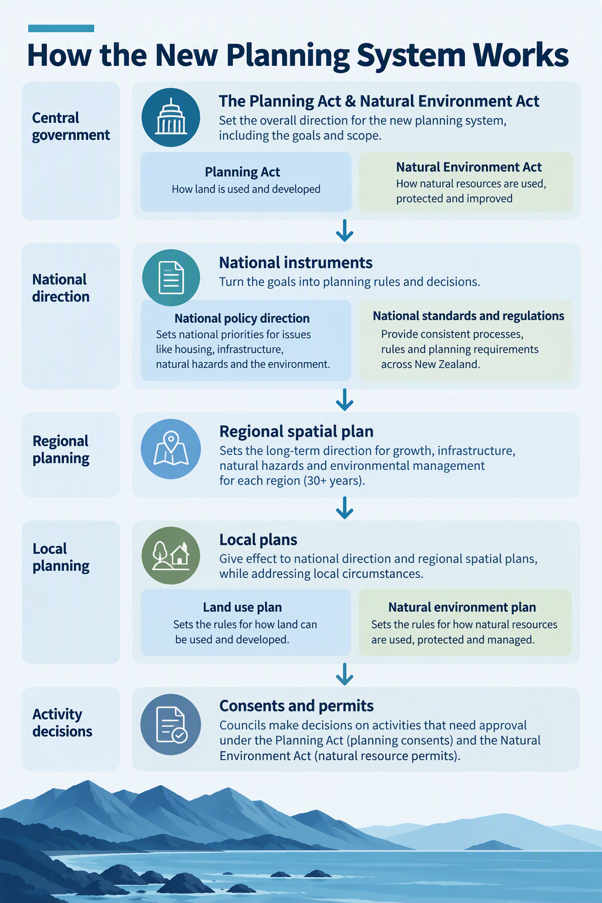
The new system creates a clearer hierarchy for planning decisions.
1. National Direction
Central Government sets national priorities through:
- National Policy Direction
- National Standards
- Regulations
These establish nationally consistent rules and expectations.
2. Regional Spatial Plans
Each region will prepare a Regional Spatial Plan that looks at growth and development over at least the next 30 years.
These plans will identify:
- areas for future growth
- strategic infrastructure corridors
- natural hazard risks
- key environmental constraints
- long-term investment priorities.
Regional Spatial Plans are intended to help coordinate decisions across councils, infrastructure providers, iwi, communities and central government, and improve coordination between planning, infrastructure funding and investment decisions across regions.
3. Local Plans
Councils will prepare:
- Land Use Plans under the Planning Act (prepared by district councils)
- Natural Environment Plans under the Natural Environment Act (prepared by the regional councils)
These plans will give effect to national direction and the regional spatial plan while addressing local circumstances.
4. Consenting
Councils will continue to make decisions on activities requiring approval.
Under the new system:
- Land-use approvals will become Planning Consents.
- Regional consents will become Natural Resource Permits.
Frequently Asked Questions
Do I still need a resource consent?
In many cases, yes.
During the transition period, existing District Plan rules generally remain in place. However, consent authorities must disregard certain matters specified in the legislation when processing district land-use activities and notices of requirement.
Is the Kaikōura District Plan still in effect?
Yes. The District Plan remains operative until replacement plans are developed under the new planning system.
What is the impact on existing resource consents?
Existing resource consents remain valid and will continue to have legal effect during and after the transition period, subject to any transitional provisions enacted by Parliament.
Some existing RMA resource consents that would otherwise expire during the transition period may receive an automatic extension, although some exclusions apply, particularly for certain water-related and wastewater-related consents.
Will fewer activities require consent in the future?
The Government expects more activities will be permitted where they comply with national and local planning rules, reducing the need for resource consents in some circumstances, once the new legislation is fully implemented.
Will the public still be able to have a say?
Yes. Public participation remains part of the planning system through plan-making, spatial planning processes and other statutory consultation opportunities.
Where can I find more information?
Visit:
or contact Kaikōura District Council's Planning Team.